AI Proof of Concept / MVP
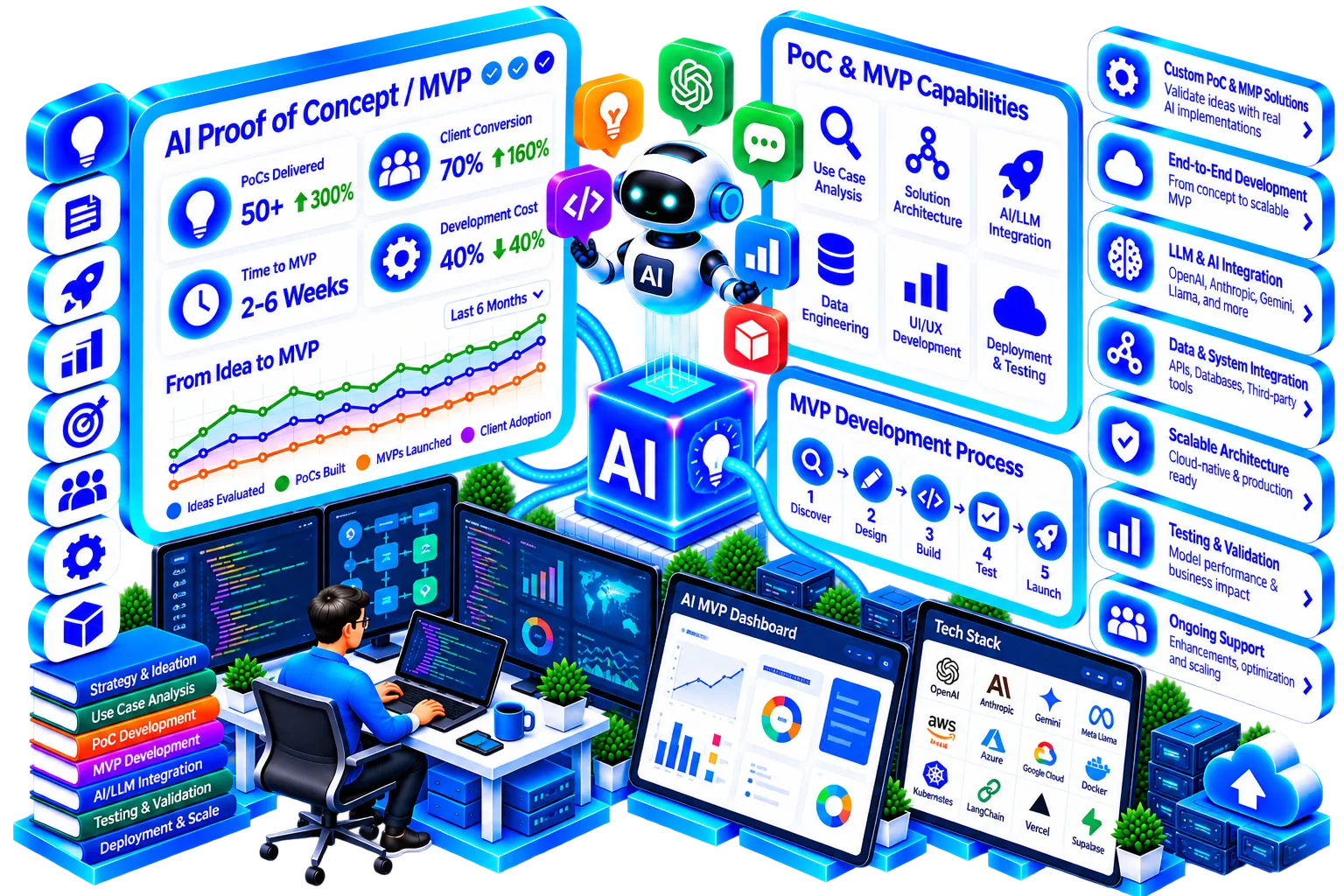
Why AI Proof of Concept / MVP
- A working proof of concept built against your real data or workflow
- A clear answer to the feasibility question agreed at the start
- Evaluation criteria and findings from the test
- A documented list of limitations, risks and open decisions
- A recommendation for the next build, pause or change in direction
The cheapest way to find out if an AI idea works is to build the smallest version that actually tests it, against real data, before committing to a larger project.
DashCloud's AI proof-of-concept and MVP engagements are scoped tightly — usually a few weeks — to validate one specific question: does this approach work well enough, on our real data, to be worth building further.
Inside AI Proof of Concept / MVP
Scoped proof of concept
A working prototype built against your real data, answering one specific feasibility question rather than trying to cover every use case.
- →One specific technical or product question
- →Smallest implementation that can answer it
- →Real inputs instead of a disconnected demo
OUTPUT Evidence-backed feasibility answer
MVP development
A minimal but real version of the product, usable enough to get in front of actual users and learn from it.
- →Minimal usable product surface
- →Enough workflow to test with real users
- →Feedback captured for the next iteration
OUTPUT Working MVP ready for learning
Answer the question before funding the full build
Founders
Validate an AI product idea before raising or committing significant budget.
Product teams
Test whether an AI feature is technically feasible before scoping a full build.
Leadership teams
See a working example before approving a larger AI investment.
Data teams
Find out whether the available data can support the quality the use case needs.
Operations teams
Test an AI workflow in the context where people will actually use it.
Innovation teams
Turn an uncertain idea into a small, reviewable experiment with a defined outcome.
Built around real teams
Founders
Validate an AI product idea before raising or committing significant budget.
- What is the one question we need answered?
- What would make the approach worth continuing?
- What data can we test with now?
Product teams
Test whether an AI feature is technically feasible before scoping a full build.
- What is the smallest useful workflow?
- Which users should try it?
- What feedback will change the direction?
Leadership teams
See a working example before approving a larger AI investment.
- What evidence does leadership need?
- What risks should stop a larger investment?
- What would the next phase cost and require?
From uncertain idea to evidence you can act on
- 01
Discover
Agree on the one specific question this proof of concept needs to answer.
Output: One feasibility question and success criteria - 02
Prototype
Build the smallest version that genuinely tests it, against your real data.
Output: Working proof tested on real inputs - 03
Build
Extend into an MVP if the proof of concept validates the approach.
Output: Findings, limitations and evaluation readout - 04
Deploy & support
Hand off findings and, if you want to continue, move into a full build.
Output: Go, pause or change-direction recommendation
Test one idea, or take it through MVP
Focused proof of concept
Answer one specific feasibility question before committing to a larger build.
- ✓One clearly defined question
- ✓Working prototype on real data
- ✓Practical evaluation criteria
- ✓Findings and next-step recommendation
AI MVP development
Turn a validated approach into a minimal product that real users can try.
- ✓Validated product scope
- ✓Usable workflow and interface
- ✓Feedback from real users
- ✓Technical path toward the next release
Full-build hand-off
Move from proven idea to a larger product build with less uncertainty.
- ✓Proof-of-concept code and findings
- ✓Prioritized product backlog
- ✓Architecture and delivery guidance
- ✓Option to continue with DashCloud or your team
Everything you need to know
Still have questions?
Can't find what you're looking for? Talk to our team and we'll point you in the right direction.
Contact usUsually a few weeks, scoped tightly to answer one specific feasibility question rather than build a complete product.
That's a valid and useful outcome — it saves you from committing a much larger budget to an approach that wouldn't have worked.
Yes — it's yours, whether you continue with DashCloud into a full build or take it elsewhere.