
AI Agents Development
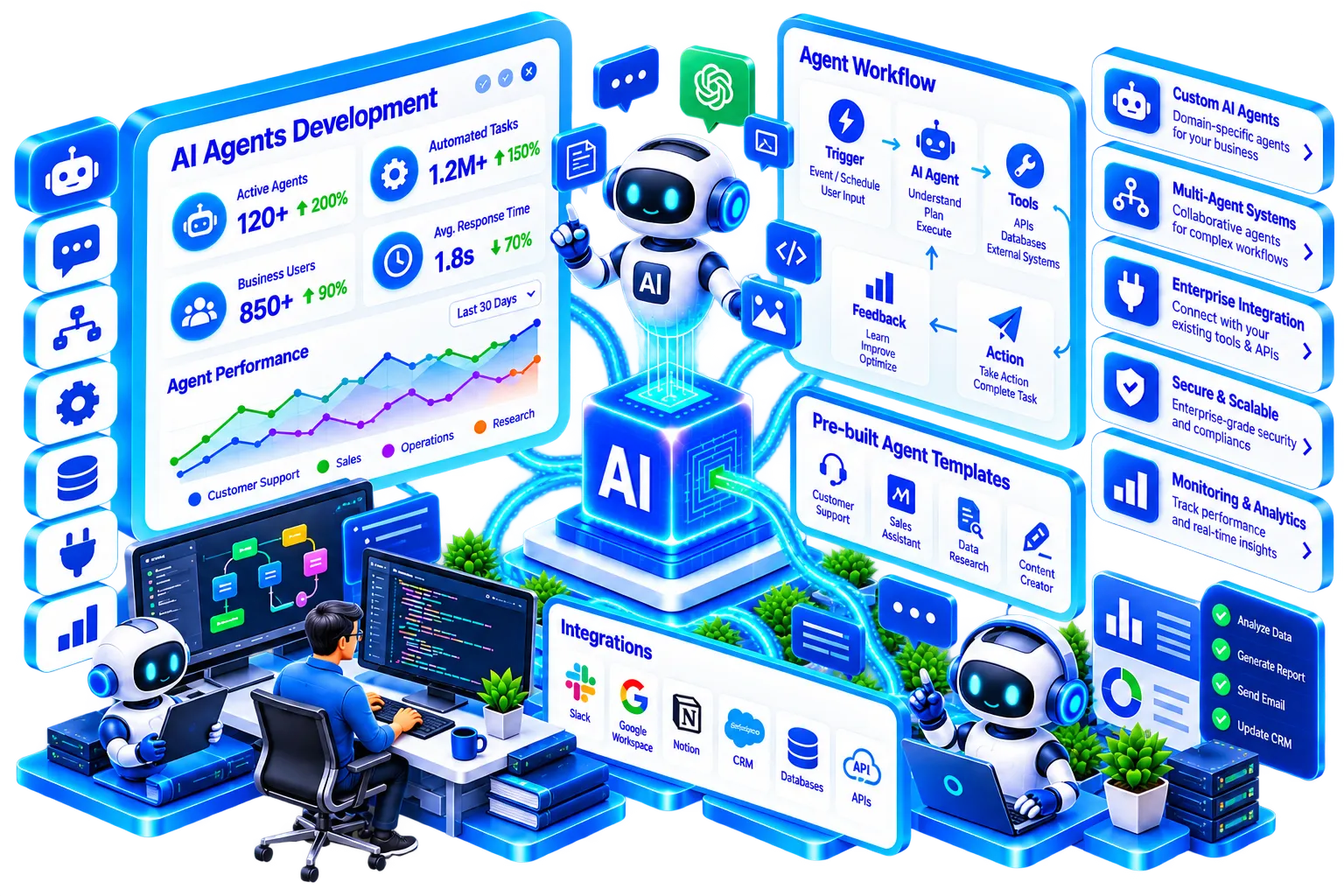
Why AI Agents Development
- A working agent scoped to one clearly defined task
- Connections to your APIs, databases and internal tools
- Guardrails and permissions set with you
- Logging on every decision and action the agent takes
- Approval gates and an escalation path to a person
An AI agent goes further than a chatbot: it breaks a goal into steps, calls the tools and APIs it needs, and adjusts when a step doesn't go as expected.
DashCloud builds agents scoped to specific, well-defined tasks — processing a claim, qualifying a lead, reconciling a report — with clear guardrails on what the agent can and can't do without a human checking in. We're deliberately conservative about full autonomy: every agent we ship has a defined scope, logging, and an escalation path to a person.
Inside AI Agents Development
Multi-agent systems
Multiple specialized agents coordinating on a larger task — one that plans, one that executes, one that checks the work.
- →A planner, an executor and a checker agent
- →Clear hand-offs between agents
- →Shared context and a single audit trail
OUTPUT Coordinated multi-agent system
Agentic workflows
A single agent working through a defined multi-step process — gathering information, calling tools, and producing a result or a recommendation for review.
- →A defined multi-step process, mapped end to end
- →Tool and API calls to your systems
- →A result, or a recommendation for review
OUTPUT Agent running your workflow
Human-in-the-loop controls
Approval gates and escalation paths so an agent hands off to a person exactly when it should, not silently past its confidence.
- →Approval gates for high-stakes actions
- →Escalation to a person when confidence is low
- →Scoped permissions and full action logs
OUTPUT Guardrails and hand-off rules
Where agents take real work off your plate
Claims and requests
Collect the details, check them against your records and prepare a decision for review.
Lead qualification
Research an inbound lead, score it against your criteria and route it to the right person.
Report reconciliation
Match records across systems and flag only the exceptions a person needs to look at.
Support requests
Resolve routine requests end to end and escalate anything unclear to your team.
Operations checks
Check several systems, apply your rules and take the next step in a multi-step process.
Research and briefs
Gather information from your sources and return a structured summary for review.
Built around real teams
Operations teams
Automate a multi-step process that today requires someone to check several systems and make a judgment call.
- Which multi-step process is worth automating first?
- What should the agent do without asking?
- Where does a person step in?
Support teams
Let an agent resolve routine requests end-to-end while escalating anything unclear to a human.
- Which requests can be resolved end to end?
- When should it escalate?
- How do we see what it did?
Finance teams
Reconcile records and flag exceptions automatically, with a person reviewing only what the agent isn't confident about.
- How do we keep a person reviewing the right items?
- What can the agent change in our records?
- How are exceptions flagged?
From a scoped task to a trusted agent
- 01
Discover
Define the task's scope precisely — what the agent should and should not be allowed to do on its own.
Output: Task scope and agent boundaries - 02
Prototype
Build a working agent against real data with logging on every decision it makes.
Output: Working agent with decision logs - 03
Build
Add guardrails, escalation paths and monitoring before anything touches production data.
Output: Guardrails, escalation and monitoring - 04
Deploy & support
Roll out with a human review step, then loosen oversight only as trust is earned.
Output: Agent live with a human review step
Start with one agent, or build a team of them
Single-task agent
One agent working through one well-defined, multi-step process.
- ✓One clearly scoped task
- ✓Connections to your tools and APIs
- ✓Logging on every action
- ✓A review step before anything irreversible
Multi-agent system
Specialized agents coordinating on a larger task, with a checker on the work.
- ✓Planner, executor and checker agents
- ✓Hand-offs and shared context
- ✓Approval gates and escalation paths
- ✓Monitoring across the whole system
Rollout and oversight
Move an agent into production and loosen oversight only as trust is earned.
- ✓Rollout with a human review step
- ✓Review of decisions and exceptions
- ✓Scope and permission changes with you
- ✓Support as usage grows
What we work with
 OpenAI
 Anthropic
 LangChain
 Python
 Node.jsOpenAIAnthropicLangChainPythonNode.jsOpenAIAnthropicLangChainPythonNode.jsOpenAIAnthropicLangChainPythonNode.jsOpenAIAnthropicLangChainPythonNode.jsOpenAIAnthropicLangChainPythonNode.jsOpenAIAnthropicLangChainPythonNode.jsOpenAIAnthropicLangChainPythonNode.jsOpenAIAnthropicLangChainPythonNode.jsOpenAIAnthropicLangChainPythonNode.js
Everything you need to know
Still have questions?
Can't find what you're looking for? Talk to our team and we'll point you in the right direction.
Contact usNot by default. Every agent we build has a defined scope and an escalation path — full autonomy is something we add gradually, only where it's been proven safe.
A chatbot answers questions. An agent plans a sequence of steps, calls tools or APIs to carry them out, and adapts when something doesn't go as expected.
Yes — agents are built to call your APIs, databases and internal tools directly, within whatever permissions you set.
Scoped permissions, logging on every action, and approval gates for anything irreversible or high-stakes — decided with you during scoping.