MLOps & LLMOps
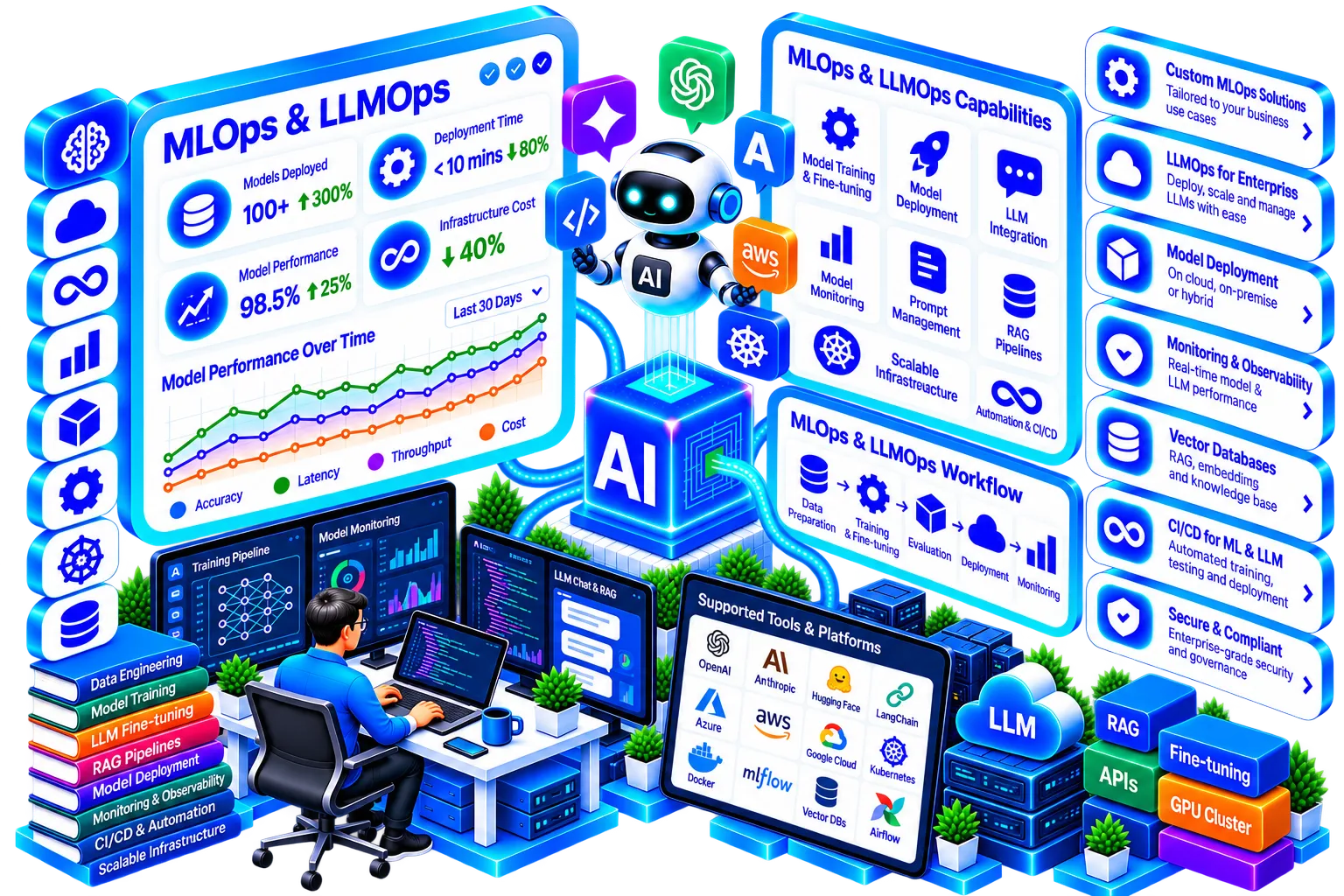
Why MLOps & LLMOps
- An evaluation set built from representative real-world inputs
- Quality checks for model, prompt or retrieval changes before release
- Labeling workflows with review and data-quality controls
- Production monitoring for performance, usage and drift
- A documented release process your engineering and product teams can run
An AI system that works well in testing can still drift, degrade or fail quietly in production if there's no process watching it.
DashCloud's MLOps and LLMOps work builds the operational layer around your models and AI features — evaluation, monitoring, data pipelines — so reliability is something you can measure and maintain, not just hope for.
Inside MLOps & LLMOps
AI testing and evaluation
Building the evaluation suite that tells you whether a model or prompt change actually improved things, before it reaches production.
- →Test cases drawn from real user or business inputs
- →Quality criteria for accuracy, relevance and safety
- →Before-and-after comparisons for every change
OUTPUT Evaluation suite and release baseline
Data annotation and labeling
Setting up the labeling workflows and quality checks that keep training and evaluation data accurate.
- →Signals from live model and LLM behavior
- →Drift and degradation alerts
- →Feedback loop from production back to the team
OUTPUT Monitored AI system with drift visibility
Monitoring and drift detection
Watching production AI systems for degraded performance over time, so issues get caught before users notice.
- →Structured labeling tasks and reviewer guidance
- →Quality checks for training and evaluation data
- →Traceable datasets for repeatable experiments
OUTPUT Reliable data and labeling workflow
Make AI measurable in production
Engineering teams
Know whether a prompt or model change is actually an improvement before shipping it.
Data teams
Build reliable labeling workflows for training and evaluation data.
Product teams
Catch AI feature degradation in production before it becomes a support ticket.
LLM application teams
Compare model, prompt and retrieval changes against the behavior users need.
Machine learning teams
Move from experiments to repeatable training, deployment and model monitoring.
AI operations owners
Give the organization a visible operating process for models already in production.
Built around real teams
Engineering teams
Know whether a prompt or model change is actually an improvement before shipping it.
- What does a good answer or prediction look like?
- Which cases must never regress?
- Can we compare changes before release?
Data teams
Build reliable labeling workflows for training and evaluation data.
- Who labels and reviews the data?
- How do we measure label quality?
- Which examples should enter the evaluation set?
Product teams
Catch AI feature degradation in production before it becomes a support ticket.
- How will we know quality is slipping?
- What signals should trigger an investigation?
- Who owns the response when the model drifts?
From model changes to reliable releases
- 01
Baseline
Review your current models, prompts, data and failure modes so the important signals are measurable.
Output: Current-state and failure-mode baseline - 02
Evaluate
Build representative test sets and quality checks that compare changes against the behavior you need.
Output: Evaluation set and quality checks - 03
Operate
Connect labeling, deployment and monitoring workflows so the team can release with confidence.
Output: Operational workflows and monitoring - 04
Improve
Track drift and production feedback, then turn what you learn into the next evaluation or training cycle.
Output: Repeatable improvement cycle
Add the missing checks, or build the full operating layer
Evaluation foundation
Make one model or AI feature measurable before the next release.
- ✓Realistic evaluation set
- ✓Quality criteria and scoring
- ✓Change comparison workflow
- ✓Release-ready report
MLOps and LLMOps layer
Connect evaluation, data, deployment and monitoring across production AI.
- ✓Evaluation and release checks
- ✓Labeling and data workflows
- ✓Production monitoring and drift
- ✓Team operating documentation
Reliability support
Keep models and AI features useful as data, users and models change.
- ✓Regular quality reviews
- ✓New test cases and labels
- ✓Drift investigation
- ✓Support for model or prompt updates
What we work with
 PythonMLflow


 Cloud AI platforms (AWS / Azure / GCP)


 Vector databasesPythonMLflowCloud AI platforms (AWS / Azure / GCP)Vector databasesPythonMLflowCloud AI platforms (AWS / Azure / GCP)Vector databasesPythonMLflowCloud AI platforms (AWS / Azure / GCP)Vector databasesPythonMLflowCloud AI platforms (AWS / Azure / GCP)Vector databasesPythonMLflowCloud AI platforms (AWS / Azure / GCP)Vector databasesPythonMLflowCloud AI platforms (AWS / Azure / GCP)Vector databasesPythonMLflowCloud AI platforms (AWS / Azure / GCP)Vector databasesPythonMLflowCloud AI platforms (AWS / Azure / GCP)Vector databasesPythonMLflowCloud AI platforms (AWS / Azure / GCP)Vector databasesPythonMLflowCloud AI platforms (AWS / Azure / GCP)Vector databasesPythonMLflowCloud AI platforms (AWS / Azure / GCP)Vector databases
Everything you need to know
Still have questions?
Can't find what you're looking for? Talk to our team and we'll point you in the right direction.
Contact usBasic evaluation is worth having from day one; more involved monitoring and drift detection typically becomes valuable as usage and stakes grow.
MLOps covers traditional machine learning model operations; LLMOps is the equivalent discipline for language-model-based systems, which have different failure modes and evaluation needs.
Yes — evaluation and monitoring can be added around models or AI features built elsewhere.